

Custom Mobile App Development: What Businesses Should Expect From the Process
November 10, 2026
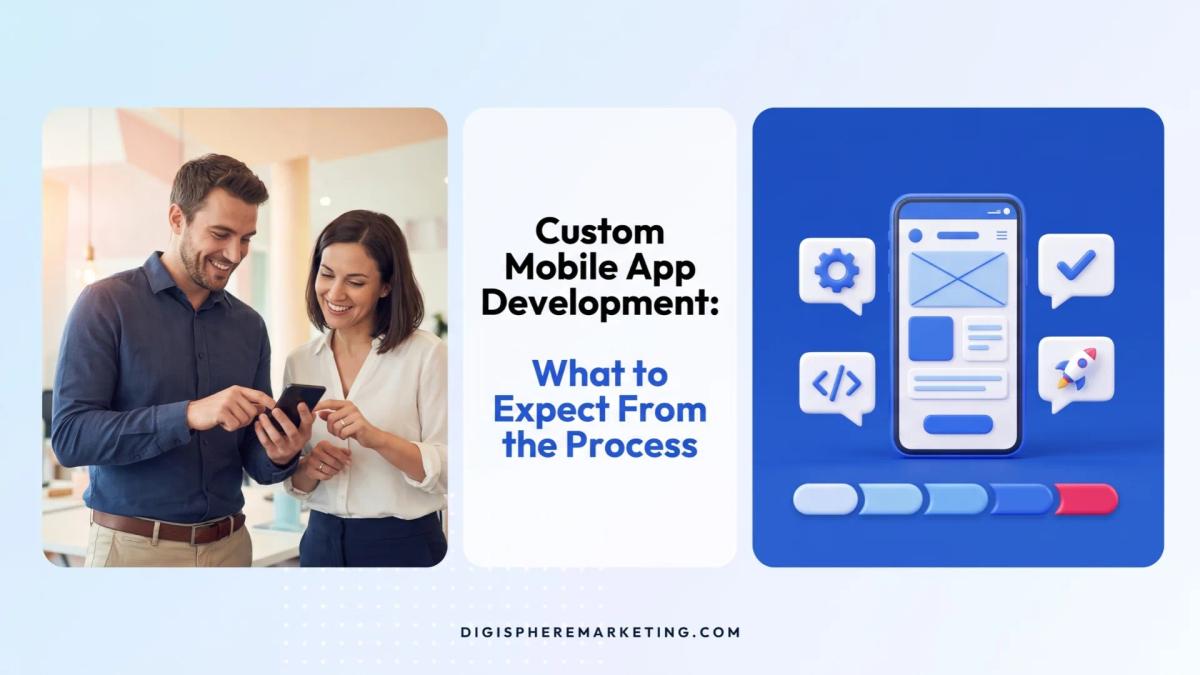
Custom mobile app development is a staged process that takes a business from an idea to a launched app through discovery, design, development, testing, and release.
Most business owners are told what an app will do and when it will launch, but not what happens in between. That gap is where budgets stretch and timelines slip, because decisions that should have been made early get made late.
This guide explains each stage in plain terms, shows how to decide between a custom build, off-the-shelf software, and no-code tools, and sets realistic expectations for timelines and for working with an app development agency.
The Custom App Development Process, Stage by Stage
Every custom app project moves through the same five stages. The names vary between agencies, but the work does not. Knowing what each stage should produce lets you judge whether a project is on track.
1. Discovery and Scoping
Discovery is where the project is defined before anything is designed or built. The team works with you to document the business goal, the people who will use the app, the features it needs, the systems it must connect to, and how success will be measured.
The output should be a written scope and a prioritized feature list that separates what the first version must include from what can wait. This stage prevents most budget and timeline surprises. Any agency that gives you a firm estimate before it has done discovery is guessing.
2. Design
Design turns the scope into something you can see. It usually starts with user flows and wireframes that map how a person moves through the app, followed by the visual design and a clickable prototype.
This is the cheapest place to change your mind. Moving a button or rethinking a screen takes minutes in a prototype and far longer once it has been coded, so review the prototype carefully and give feedback before approving it.
3. Development
Development is where the app is built: the screens people interact with, the server and database behind them, and the connections to payment systems, CRMs, or other tools. Well-run projects build in short cycles and demonstrate working software at regular intervals.
What you should see during this stage is working builds you can open and test, not only status reports. If weeks pass without a demonstration, ask why.
4. Quality Assurance Testing
Testing confirms that the app works as specified and keeps working under real conditions. That includes functional testing of every feature, testing across devices and operating system versions, performance and security checks, and user acceptance testing, where you and your team try the app before it goes live.
Testing on real devices matters because an app that works on one phone can fail on another. Budget time for fixing what testing finds, since a round of fixes is normal and expected.
5. Launch and App Store Review
Launch is more than pressing a button. The app has to be submitted to the Apple App Store, Google Play, or both, and each store has its own review process, technical requirements, and privacy disclosures. Review times vary, and a rejected submission adds delay, so build this into your plan instead of treating it as a formality.
A good launch plan also covers analytics so you can see how people use the app, a release plan for how it reaches your customers, and a process for collecting early feedback.
DigiSphere Note: This process is one part of a larger picture. For the full overview of what app development involves and where it fits in your business, read our app development guide for business owners.
What Happens After Launch
An app is never finished at launch. Operating system updates, new devices, bug reports, and user feedback all require ongoing attention, and apps that are not maintained gradually stop working or fall out of the stores.
Plan for maintenance and a feature roadmap from the start, and ask any agency what support looks like after release. Launching with a focused first version and improving it with real user data is usually a better path than trying to build everything at once.
Build vs. Buy vs. No-Code: A Decision Framework
Custom development is not always the right answer. Before commissioning a build, compare it against the two alternatives.
| Option | Best When | Tradeoffs |
|---|---|---|
| Buy: existing app or off-the-shelf software | Your need is common, speed matters, and the app is not a point of difference for your business | Limited customization, recurring license fees, and you adapt your process to the tool |
| No-code or low-code platform | You are validating an idea, building an internal tool, or need a simple workflow quickly | Platform limits on performance and design, and dependence on the platform's pricing and future |
| Build: custom development | The app is central to your business, needs complex integrations, or must scale and be fully owned by you | The longest timeline and the largest upfront investment of the three options |
Four questions usually settle the decision:
- Is the app a point of difference for your business, or a supporting tool?
- Does an existing product already cover most of what you need?
- How many other systems does the app need to connect to?
- What happens to the app if usage grows tenfold?
If your project reaches beyond a mobile app into web platforms and back-office systems, our custom software development services cover that broader scope.
Realistic Timeline Expectations by Project Complexity
No honest agency can give a timeline before discovery, because the scope drives the schedule. What you can know in advance is how complexity changes the shape of a project.
| Complexity | Typical Scope | Relative Timeline |
|---|---|---|
| Simple | One platform, a small set of core screens, and standard features such as accounts, booking, or content | The shortest of the three |
| Moderate | Both platforms, integrations with payments or a CRM, and an admin dashboard | Noticeably longer, with more design, build, and testing work |
| Complex | Custom backend, real-time features, several integrations, advanced security, or regulatory requirements | The longest, often delivered in phases |
Several things stretch any timeline: an unclear scope, slow feedback on designs, third-party integrations that behave differently than documented, content that is not ready, and app store review. The same factors drive cost, which is why a scoped estimate after discovery is the only reliable number for your project.
What to Expect From an App Development Agency
Choosing a mobile development agency is as important as choosing the approach. A capable partner should give you:
- A written scope and a milestone-based plan before development starts
- Regular demonstrations of working software, not only reports
- Ownership of your source code and your developer accounts
- Testing built into the plan, not added as an afterthought
- A clear support and maintenance plan after launch
Our guide to the questions to ask before hiring an app developer goes deeper on how to evaluate a partner before you sign.
Decide Your Platform Early
One decision that affects every stage is which platform to build for first, or whether to build cross-platform. It shapes design, development, testing, and launch, so settle it during discovery. Our guide to iOS vs. Android app development walks through how to choose.
Frequently Asked Questions
What is custom mobile app development?
Custom mobile app development is the design and building of an app made specifically for your business, goals, and customers, as opposed to using a ready-made product. It covers discovery, design, development, testing, and launch, and it gives you full control over features, appearance, and ownership.
How long does it take to build a custom mobile app?
It depends on scope. A simple app on one platform takes the least time, an app with integrations and both platforms takes longer, and a complex app with a custom backend takes the longest and is often built in phases. An accurate timeline is only possible after discovery defines what you are building.
What is the difference between a custom app and a no-code app?
A custom app is built from code to your exact requirements, so you control performance, design, and ownership. A no-code app is assembled on a platform with pre-built components, which is faster for simple needs but limited by what the platform allows. No-code often works well to validate an idea before investing in a custom build.
What does a mobile app development agency do?
An app development agency manages the full process: it scopes the project, designs the experience, builds and tests the app, handles app store submission, and supports it after launch. DigiSphere offers custom app development services that cover each stage.
Will I own the code for my custom app?
You should. Ownership of the source code and the developer accounts should be spelled out in your contract before work begins. If an agency is unwilling to confirm it, treat that as a warning sign.
Thinking about a custom app? DigiSphere will review your idea, recommend whether to build, buy, or start with a no-code tool, and outline the stages and timeline for your project.
Get Your Free App Scoping Consultation